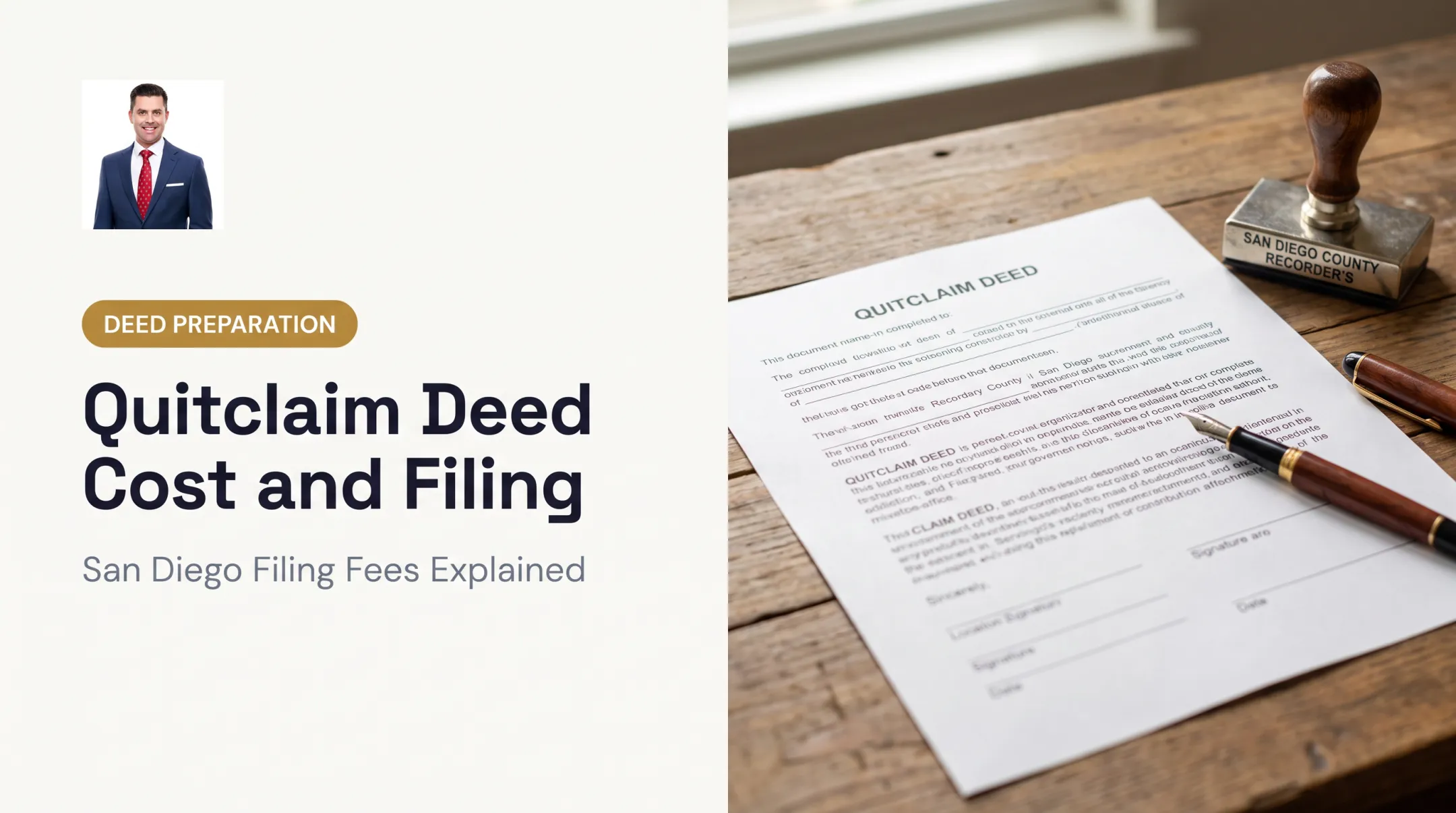

Notarizing a quitclaim deed sounds simple. It isn't always. Requirements vary by state, and even small mistakes, like signing before the appointment or leaving a field blank, can delay or invalidate the entire transfer.
This guide covers the exact notarization steps, what to bring, how state rules differ, common mistakes people make, and what to do if your situation involves a living trust.
TL;DR
- Nearly every state requires notarization before a quitclaim deed can be recorded
- The grantor must appear in person with valid, unexpired photo ID
- After notarization, the deed must be filed with the county recorder to become official public record
- Fees, witness rules, and forms differ by state
- Trust-related transfers often need professional deed preparation to avoid title problems later
How to Notarize a Quitclaim Deed
Step 1: Complete and Review the Deed Before Signing
Before scheduling anything, confirm the deed itself is correct.
- Names: Grantor and grantee names must be spelled exactly as they appear on other title documents
- Legal description: The property's legal description (not just the street address) must be included
- Transfer language: The document needs proper conveyance wording for a quitclaim
- No blanks: Notaries cannot notarize documents with incomplete fields
Also check that you're using the correct form for your county. Requirements differ by jurisdiction, and an outdated template can get the deed rejected even after it's properly notarized.

Step 2: Locate a Notary Public and Schedule an Appointment
You have several options, depending on your state's rules:
- Bank notaries (often free for account holders)
- UPS stores or shipping centers
- Mobile notaries who travel to you
- Online/remote notarization, where permitted
Here's the catch: some states require the deed to be signed in the notary's physical presence, meaning you cannot pre-sign it at home and bring it in. If multiple grantors need to sign, coordinate everyone's appearance in advance, whether that's one shared appointment or separate sessions.
Remote online notarization (RON) is now authorized in 48 states and DC, according to the American Land Title Association. But authorization doesn't guarantee your county recorder will accept an electronically notarized deed, so confirm that separately before you rely on it.
Step 3: Appear in Person With Valid Identification
Notaries typically accept:
- State-issued driver's license
- U.S. passport
- Other government-issued photo ID
The notary will verify your identity, confirm you're signing willingly, and may ask you to confirm your understanding of the document. Some states also require one or two witnesses in addition to the notary.
Florida, Kentucky, West Virginia, and Texas all allow a subscribing-witness route as an alternative to notarization under their recording statutes, but this is a formal proof procedure, not a casual "two friends sign" shortcut.
Step 4: Sign the Deed and Receive Notarial Certificate
Once identity is confirmed, you sign the deed in the notary's presence. The notary then:
- Completes an acknowledgment certificate with their signature, seal, and commission details
- Logs the transaction in their journal, required in states like California
- May ask you for a thumbprint on real-property documents (California requires this for quitclaim deeds specifically)
Some states also require the grantee to sign, even though a quitclaim only transfers interest one direction. Check your state's requirements before the appointment so you're not scrambling for a second signer.

Step 5: Record the Notarized Deed With the County
Notarization alone doesn't finish the job. You still need to file the deed with the county recorder's office where the property sits.
Recording typically requires:
- The original signed and notarized deed
- A completed transfer tax form (in California, this is the Preliminary Change of Ownership Report)
- Payment of the recording fee
Until it's recorded, the transfer might not hold up against third parties. California's Civil Code makes this distinction clear: an unrecorded deed remains valid between the parties but can be voided against a later good-faith buyer who records first.
Does a Quitclaim Deed Always Need to Be Notarized?
Almost every state requires notarization for a deed to be recordable.
A handful of states—Florida, Kentucky, West Virginia, and Texas—allow proof by subscribing witnesses as an alternative. Even that route still requires formal proof before a clerk or authorized officer, not just casual bystanders.
Skip notarization where it's required and you risk:
- The deed being enforceable only between the original parties
- Outright rejection by the recorder
- Difficulty proving authenticity if a dispute arises later
Even in states where it's technically not required, notarizing protects you against future challenges to the deed's validity. It's cheap insurance for a document that could otherwise sit in legal limbo for years.
What You Need Before Notarizing a Quitclaim Deed
Showing up prepared prevents wasted appointments and repeat trips.
Documents and Identification
- Valid government-issued photo ID for each grantor
- A completed but unsigned deed
- The property's full legal description
Fees and Logistics
Notary fees are typically charged per signature, not per document. State caps vary:
- California: up to $15 per signature
- Florida: up to $10 per notarial act
These fees are separate from county recording charges. Recording often runs roughly $20–$30 in many California counties, but amounts vary widely. Check your local recorder's fee schedule.

Special Situations
If a signer is out of state, incapacitated, or otherwise unable to appear in person, options include:
- A mobile notary who travels to the signer's location
- Remote online notarization, where the state and county both accept it
- Coordination with a document preparer familiar with cross-jurisdiction signings
Common Mistakes When Notarizing a Quitclaim Deed
These errors show up again and again, and each one can send you back to square one:
- Signing before the appointment: Invalidates the notarization entirely; the notary must witness the actual signature.
- Using expired ID: An outdated driver's license or passport will get you turned away.
- Leaving blank fields: Incomplete deeds or outdated county templates get rejected on the spot.
- Forgetting to record: A deed that never reaches the county recorder leaves the transfer legally incomplete.
State-Specific Considerations and When to Get Professional Help
Recording fees, transfer tax exemptions, and witness requirements shift from state to state and even county to county. Always confirm local rules before your appointment rather than assuming your neighbor's process applies to you.
This matters even more for property moving into or out of a living trust. A deed that's improperly prepared, or never recorded at all, can leave a home outside the trust even when the trust document itself looks complete. That gap often surfaces years later during a refinance or sale, when a title company flags the mismatch.
Marco Mariani, a California Licensed Document Assistant (LDA #231) with 33 years of experience, has seen this pattern repeatedly. Through HomeTrust, he prepares deeds and trust documents for San Diego homeowners. Common issues he encounters during trust amendment and correction engagements include:
- Trusts that were signed but never funded because the deed was never recorded
- Refinances that inadvertently move property out of the trust, with no deed filed to move it back
- Newly purchased or inherited property titled personally instead of in the trust's name

If you're transferring California property into or out of a trust, professional document preparation helps close these gaps before a refinance or sale exposes them. HomeTrust's trust package, starting at $409 / settlor plus recording and notary fees per Settlor, includes deed preparation alongside the trust, pour-over will, power of attorney, and healthcare directive. Notary and county recorder fees are billed separately.
Frequently Asked Questions
Does a quitclaim deed need to be notarized?
Almost every state requires notarization before the deed can be recorded. A few states allow subscribing-witness proof instead, but that's a formal alternative, not a casual workaround.
How much is the notary fee for a quitclaim deed?
Notary fees are typically charged per signature and capped by state law. California caps fees at $15 per signature; check your state's fee schedule for the exact amount.
Does a quitclaim deed need to be recorded in California?
In California, recording isn't required for the transfer to be valid between the original parties. It is needed to protect the transfer against later third-party claims, so most grantors record the deed with the county.
Does a quitclaim deed transfer ownership in Texas?
It transfers whatever interest the grantor actually holds, without any warranty. If the grantor's ownership was already flawed, the recipient inherits that same flaw.
Who benefits the most from a quitclaim deed?
Family members, divorcing spouses, and people transferring property into a living trust benefit most. These are low-risk, trust-based transfers where a title guarantee isn't the priority.
What are the requirements for a valid quitclaim deed?
A valid deed needs the grantor and grantee names, a legal property description, proper transfer language, and a notarized signature. Recording with the county where the property is located protects the transfer against later third-party claims.