
Without the right documents, a surviving spouse in California can face delays, unintended asset splits between a spouse and children, and court involvement at the worst possible time. Formal probate in California typically takes 9 to 18 months, often with real administration costs attached.
This article covers the documents married couples actually need, how California's community property rules work, tax considerations for spouses, and the mistakes that trip up even well-meaning couples.
Key Takeaways
- Marriage doesn't automatically transfer all assets or decision-making power to your spouse
- A complete plan includes a trust or will, power of attorney, and healthcare directive
- California's community property rules and living trusts can help couples avoid probate
- Failing to fund a trust after creating it is one of the costliest, most common mistakes
Does Marriage Automatically Protect Your Spouse?
Short answer: not entirely. Marriage helps, but it does not close every gap in inheritance, medical decision-making, or finances during incapacity.
Inheritance Isn't Guaranteed to Be 100%
California's intestate succession laws (when there's no will) split assets based on what type of property it is. Under California Probate Code Section 6401, a surviving spouse automatically gets the decedent's half of community property. But separate property is different:
| Situation | Spouse's Separate Property Share |
|---|---|
| No children or close relatives | Entire estate |
| One child (or issue of one deceased child) | One-half |
| More than one child (or their descendants) | One-third |
That means a spouse with children from a prior marriage might see separate property split between the surviving spouse and the kids, not automatically go 100% to the spouse.

Medical and Financial Authority Isn't Automatic Either
Being married does not give your spouse clear, undisputed authority over every medical decision if you become incapacitated. California often places a spouse first in the default surrogate hierarchy, but providers still look for an agent named in an advance healthcare directive. Without that document, decisions can stall when relatives disagree or a hospital wants stronger authorization.
The same goes for finances. A durable power of attorney requires a written designation under California law. Without it, your spouse may need court approval just to manage your bank accounts or pay bills while you're incapacitated.
Essential Estate Planning Documents Every Married Couple Needs
A complete plan for couples isn't complicated, but it does require the right pieces working together.
The core documents:
- Revocable living trust — the foundation. It lets you avoid formal probate for anything titled in the trust's name and keeps distribution private.
- Pour-over will — catches any asset you forgot to move into the trust and directs it there after death.
- Durable power of attorney — names an agent (often your spouse) to manage finances if you're incapacitated.
- Advance healthcare directive — documents your medical wishes and names a healthcare agent.

Don't Skip Guardianship Designations
If you have minor children, naming a guardian matters even if you assume your spouse will simply take over. What if something happens to both of you? Guardianship nominations are typically handled through the pour-over will, so this isn't a separate document to track down.
Bundling It All Together
HomeTrust's flat-rate California living trust package bundles the trust, pour-over will, power of attorney, and healthcare directive into one package. Preparation takes 1-3 business days.
The joint trust package for couples runs starting at $409 per person plus notary and county recorder fees. That's faster than the 2-6 weeks (sometimes longer) attorney-prepared trusts commonly take.
California Community Property and Trust Funding for Married Couples
California is a community property state, and that classification shapes how married couples title assets, fund a trust, and capture tax benefits at the first spouse’s death.
Community Property vs. Separate Property
Under California Family Code Section 760, property acquired during marriage while domiciled in California is generally community property. Separate property, by contrast, includes anything owned before marriage or received individually via gift or inheritance.
That distinction drives taxes at death. Community property gets a full step-up in cost basis when the first spouse dies—a meaningful advantage separate property does not automatically receive.
Trust Funding Is Where Plans Fall Apart
Creating a trust document is only half the job. The trust must actually hold title to your assets, a process called funding. This typically involves:
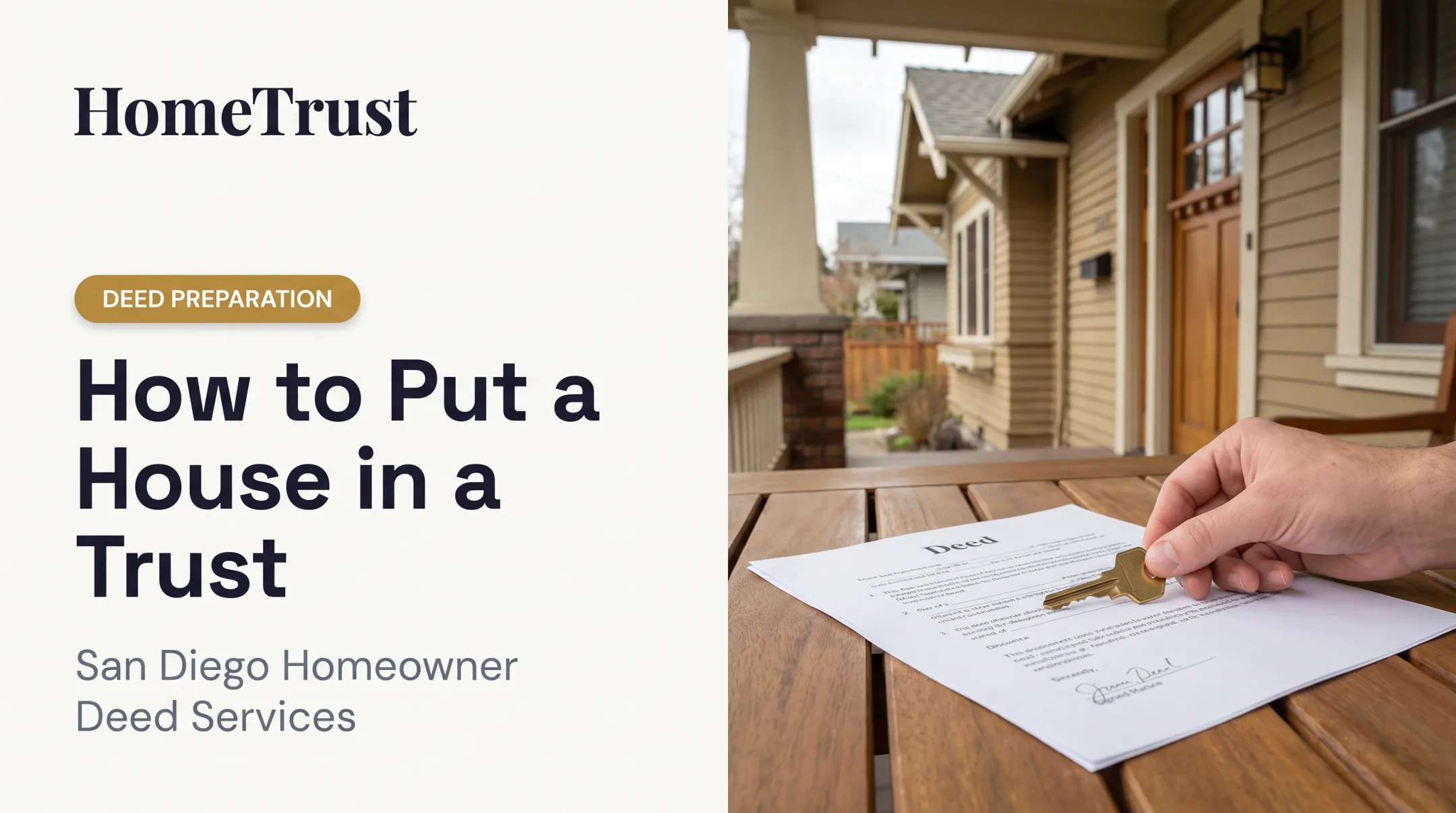
- Retitle the home: prepare a grant deed naming the trust as owner and a Preliminary Change of Ownership Report, then record both with the county to preserve the property-tax reassessment exemption
- Retitle bank accounts: bring a Certificate of Trust and photo ID to your bank; ownership updates usually finish in one visit
- Retitle investment accounts: submit the brokerage’s trust-transfer form with your Certificate of Trust (typically 5–15 business days and generally not a taxable event)

One notable exception: retirement accounts like 401(k)s and IRAs should not be transferred into the trust. Doing so can trigger immediate income tax on the entire balance. Instead, keep these accounts personally titled and simply update the beneficiary designation.
Failing to fund a trust after signing it is one of the most common and expensive mistakes California couples make. An unfunded trust protects nothing. HomeTrust’s package includes deed preparation and step-by-step funding guidance so couples finish this step and do not leave the trust empty.
Estate and Gift Tax Considerations for Married Couples
Here's some good news: most married couples won't owe federal estate tax at all.
Federal Exemption Is Higher Than You Might Think
The IRS basic exclusion amount is $13.61 million for 2024 and $13.99 million for 2025. Unless your combined estate exceeds these thresholds, federal estate tax generally isn't a concern.
Unless your combined estate exceeds these thresholds, federal estate tax generally isn't a concern. Lifetime taxable gifts draw down that same exclusion, which is why most couples never owe federal gift tax either.
The Marital Deduction
The unlimited marital deduction allows U.S. citizen spouses to transfer unlimited assets to each other tax-free, during life or at death. That said, this deduction shields spouse-to-spouse transfers, not necessarily what happens when the surviving spouse later passes assets to children.
California Has No State Estate Tax
California hasn't required a state estate tax return since 2005. That's one less layer to worry about compared to some other states.
Even without a California estate tax, larger estates still need a federal plan. For high-net-worth couples, strategies to reduce future estate tax exposure typically include:
- Using both spouses' individual exemptions through proper trust structuring
- Lifetime gifting strategies to reduce the taxable estate
- Filing Form 706 to elect portability of any unused spousal exemption

Portability isn't automatic: the surviving spouse's estate must file Form 706 on time to claim any unused exemption.
Common Estate Planning Mistakes Married Couples Make
Even well-intentioned couples make the same handful of errors repeatedly.
- Assuming a will avoids probate: It doesn't. Only a properly funded trust does; a will still goes through probate.
- Naming only a spouse as backup: If both spouses die or become incapacitated close together, every role (executor, trustee, agent) needs a named alternate.
- Skipping updates after major life events: A new child, a home purchase, or a move to another state should all trigger a plan review.
Fixing these three gaps is what turns a basic plan into one that actually works. Only 32% of American adults currently have a will, according to Caring.com's 2024 survey, down from the year before. Having something in place already puts you ahead of most couples. Having it properly funded and updated puts you further ahead still.
When and Why to Update Your Estate Plan
Estate plans aren't "set it and forget it" documents. Review yours every 3–5 years, or immediately after major life changes:
- Marriage, remarriage, or divorce
- Birth or adoption of a child
- Buying or selling property
- Moving to a different state
- Death of a named trustee, executor, or beneficiary
Beneficiary designations deserve special attention. An outdated beneficiary form on a life insurance policy or retirement account can override even a carefully drafted trust. If you named an ex-spouse as beneficiary years ago and never updated it, that designation typically still controls, regardless of what your will says.
Updating the rest of your plan is usually simpler than starting over. If your trust is several years old, a corrective deed or amendment often fixes the gap—especially when the trust was never properly funded in the first place.
Frequently Asked Questions
Are spouses subject to estate tax?
Generally no. The unlimited marital deduction shields spouse-to-spouse asset transfers from federal estate tax. However, the surviving spouse's own estate may face tax later when passed to the next generation.
What is the best way to avoid paying estate taxes?
Most estates owe no federal estate tax because they fall under the exemption. For larger estates, common tools include the marital deduction, lifetime gifting, and trusts that use both spouses' exemptions—confirm details with a tax professional.
When a husband dies, does the wife automatically inherit?
It depends on state law, whether the asset is community or separate property, and whether a will or trust exists. In community property states such as California, community property generally passes to the spouse, while separate property may be shared with children.
Should my husband be the executor of my will?
A spouse is a common, practical choice. Name a backup executor too, in case you are both unavailable or incapacitated at the same time.
What is the 7-7-7 rule for married couples?
It is an informal planning heuristic sometimes mentioned in insurance circles—not a statute or IRS rule. Do not rely on it; base decisions on your estate documents and guidance from a qualified professional.